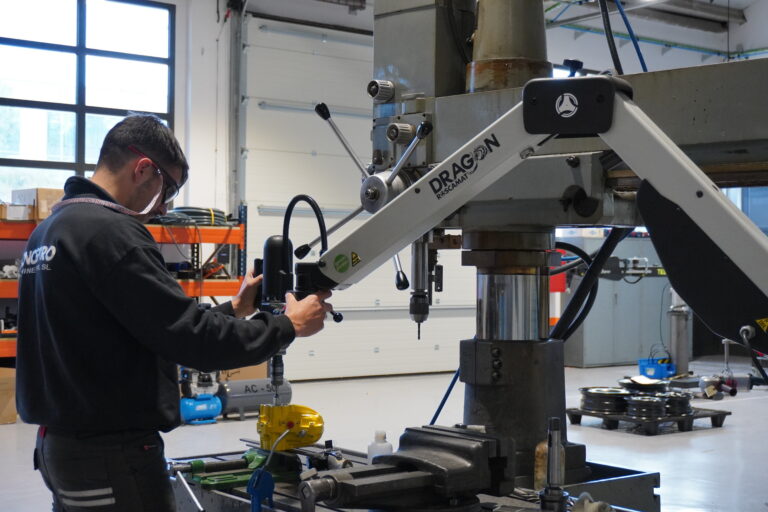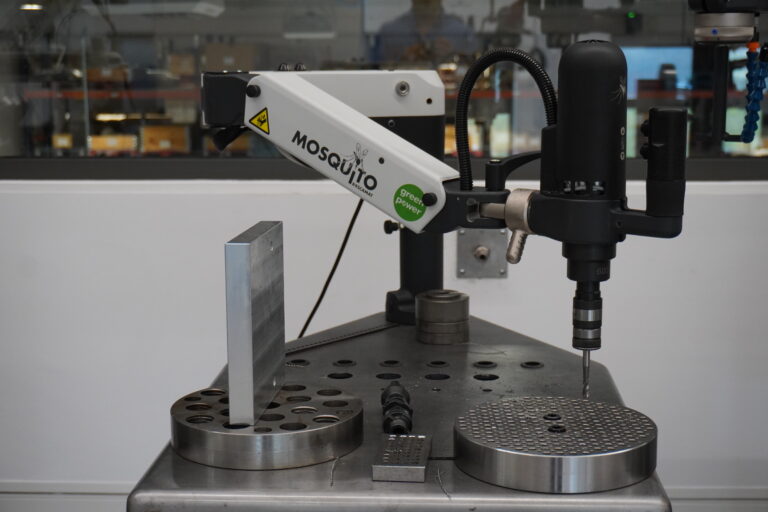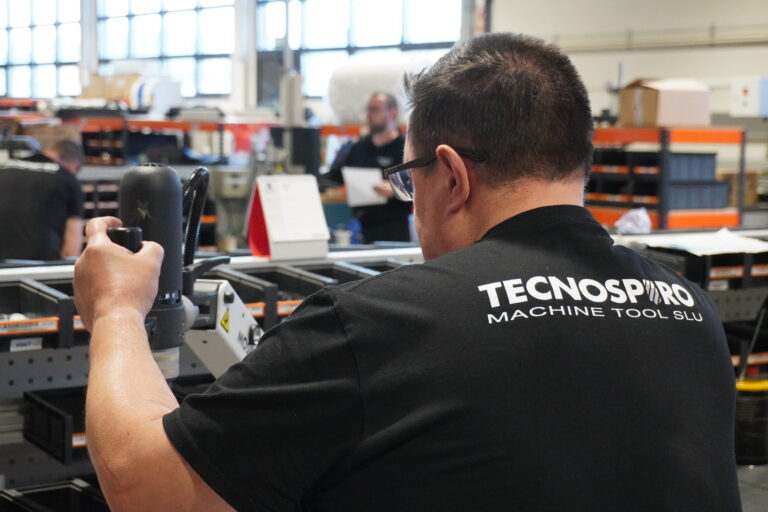
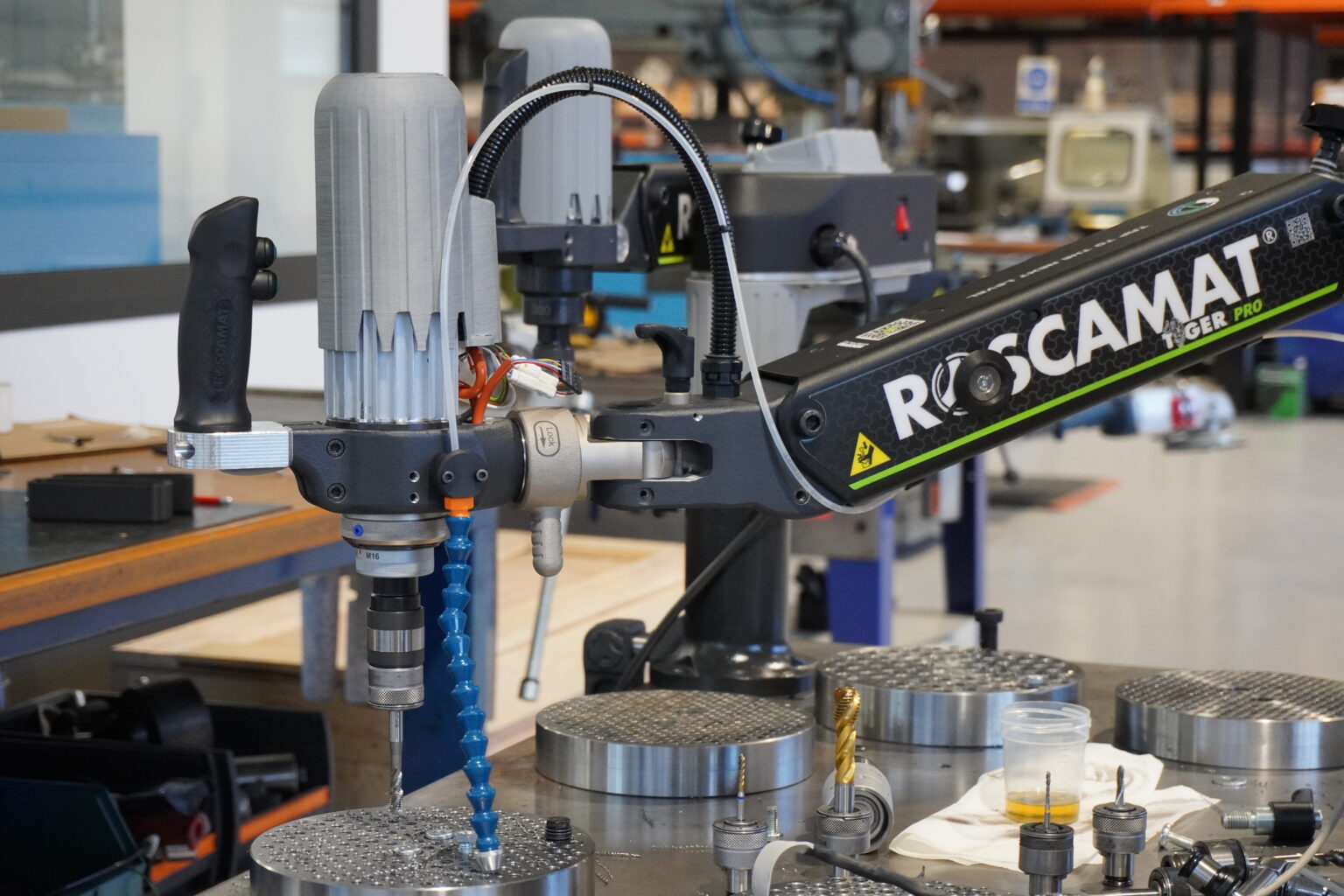
The implementation of advanced tapping solutions in European metalworking production lines responds to the critical need to eliminate hidden costs due to tap breakage and reduce cycle times in high value-added parts.
An automatic tapping machine configured with an articulated arm and high-frequency electric motorization represents the natural evolution against old and inefficient pneumatic technologies.
However, operations directors and industrial maintenance managers often face complex doubts regarding their integration, mechanical preservation protocols, and the real economic impact on their cash flows. To ensure that these electromechanical systems operate under the strict safety guidelines current in the common industrial fabric, the European Agency for Safety and Health at Work (EU-OSHA) supplies the essential regulatory frameworks aimed at harmonizing the ergonomic and safe interaction between operators and automated industrial machinery.
Advanced criteria for maintenance digitalization in the modern workshop
One of the most frequent questions among plant engineers lies in how to structure service routines to avoid micro-stops without overdimensioning operational costs.
The current answer is based on maintenance digitalization, transforming purely visual inspections into predictive strategies backed by electronic control data. Latest generation automatic tapping machines record operational variables such as the exact number of threads tapped and torque fluctuations during tap penetration.
This information allows technicians to anticipate severe wear on the chasers before a deformation in the thread pitch or a catastrophic fracture of the tool occurs inside the blind hole.
On the physical plane, the preservation of mechanical components requires maintaining a strict routine of daily cleaning of chips and debris from the tool holders to ensure concentricity.
Weekly, it is fundamental to verify the tension and alignment of the quick-change planetary reduction modules.
Likewise, the total renewal of the cutting oil and the meticulous inspection of the gas shock absorbers after one hundred and sixty hours of continuous use ensure that the weightless structure of the arm maintains minimum resistance to human guidance, reducing lateral reaction forces on the bedplate.
Feasibility analysis and return on investment calculation in B2B projects
The justification of investment in capital goods invariably centers on how quickly the injected capital returns to the company’s balance sheet. The ROI calculation for an automatic tapping machine with an articulated arm demonstrates amortization periods substantially lower than eighteen months, driven by the drastic reduction of the direct labor factor and the minimization of scrap or defective parts.
By digitalizing the process, a single workstation can manage the volume that previously required multiple operators with inefficient portable tools, allowing technical talent to be redistributed toward machining cells of greater geometric complexity.
Production volume and operational versatility constitute the pillars of this financial efficiency. Optimal amortization is reached in series exceeding one thousand components per batch, where the time invested in the preparation and change of modules is reduced to a negligible fraction of the unit cost.
Error mitigation during automation and control of plant processes
A recurring question among systems integrators is why automatic equipment fails when coupled to mass production lines. Accumulated experience shows that incidents rarely come from the tapping unit, but from poorly managed external factors, such as the misalignment of positional and optical sensors due to the accumulation of oil mist or adjacent impact vibrations. Effective process automation and control demands regular calibration and the use of digital diagnostic interfaces to verify motor encoder signals, preventing the activation of false alarms that unexpectedly stop the assembly line flow.
The second critical error vector is found in the dimensional variations of parts coming from the previous drilling stage. The presence of metallurgical burrs, inconsistencies in the internal diameter of the hole, or hard zones caused by deficient prior machining cause sharp peaks in the torque that can damage the tap. To safely process heavy structural components that demand superior rigidity against these material anomalies, the Tiger series integrates a large-scale chassis and a modular speed system with adjustable safety clutches that absorb mechanical impacts without deforming the thread.
Kinematic flexibility and insertion into smart manufacturing
The integration of the automatic tapping machine within Industry 4.0 requires the equipment to provide high adaptability to rapid production changes without penalizing downtime.
The use of VH-type steerable articulated heads allows alternating the direction of machining by a ninety-degree angle, facilitating vertical, horizontal, or inclined tapping in a single clamping of the master part. This suppresses complex flipping maneuvers of heavy components on the workbench, eliminating ergonomic risks and preventing aesthetic damage to external machined surfaces.
The versatility of advanced articulated arms extends beyond conventional tapping using taps. With the use of quick-change tool holders equipped with a safety clutch, the equipment transforms in seconds into a multitasking station suitable for countersinking, light reaming, deburring, and rapid insertion of helical threaded inserts. This multifunctionality substantially elevates the machine utilization factor in the workshop.
Precision guarantee through European industrial standardization
The adoption of high-frequency electromechanical technologies over old pneumatic systems aligns directly with the industrial sustainability policies promoted by the European Union. Electric motors optimize energy consumption by demanding power only during the active cutting cycle, eradicating the costly compressed air leaks common in factory installations.
This electromechanical efficiency contributes significantly to compliance with ISO 50001 audits on energy management in highly demanding manufacturing environments. To delve deeper into the energy efficiency standards applicable to heavy machinery within the scope of the common market, the Spanish Association for Standardization (UNE) coordinates the publication of technical quality regulations for industrial components.
The digital standardization of torque and the millimetric Z-axis dimension via integrated touchscreens eliminates dependence on the operator’s manual skill factor, homogenizing the quality of the final product regardless of the work shift. This ensures that each thread complies exactly with the geometric tolerances required by highly responsible sectors such as automotive, railway, or heavy structure construction.
The choice of an automatic tapping machine must not be limited to the evaluation of isolated nominal parameters, but must be approached as a strategic decision combining the kinematic robustness of the articulated arm with advanced maintenance digitalization and a return on investment fully backed by workshop cost reduction.
At Roscamat we develop tapping systems that eliminate variability in the final finishing phases, ensuring the integrity of your components and elevating the efficiency rates of your metalworking plant. If your organization needs to take the definitive step toward process standardization and the eradication of unscheduled stops due to tap breakage, we invite you to establish direct communication with our team. We will prepare a technical audit adapted to the materials in your factory, your production volumes, and your control requirements to provide a solution tailored to your operational goals.