Industrial Tapping Machine
An industrial tapping machine must offer more than power when integrated into a production environment: it must enable precise operation, reduce auxiliary tasks and make it easier for the operator to position the tool. At Roscamat, we develop articulated arms designed to bring the tool to the workpiece and perform machining operations with greater control, ergonomics and efficiency.
Compared with using a conventional electric tool held directly by the operator, the articulated arm supports the assembly and facilitates its movement across the working area. The result is a particularly suitable solution for workshops that need to perform multiple operations on components with different geometries without necessarily investing in an automated cell.
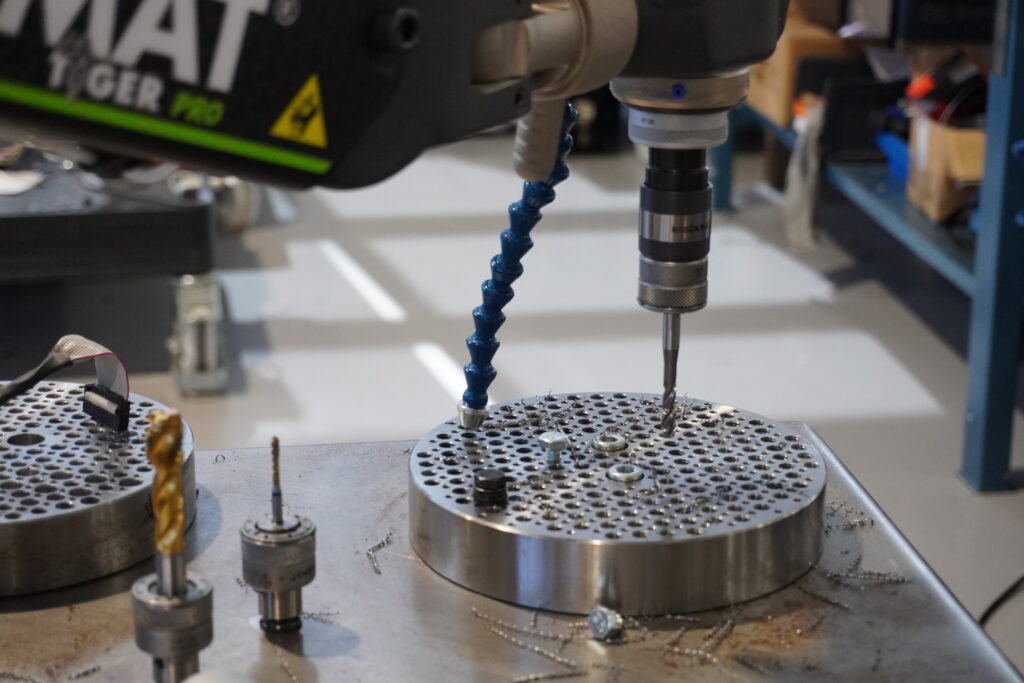
WORLDWIDE TAPPING ARM LEADER
Standing out in the European Union and with exports and services at a global level such as the United States, Latin America and many other areas.
ROSCAMAT STANDS OUT BY:
Simplicity
Versatility
Zero setup time
Ease of transfer
Reliability
PERFECT MACHINERY FOR:
Moldmakers
Die Makers
Component manufacturers
Metalwork
Machine Shops
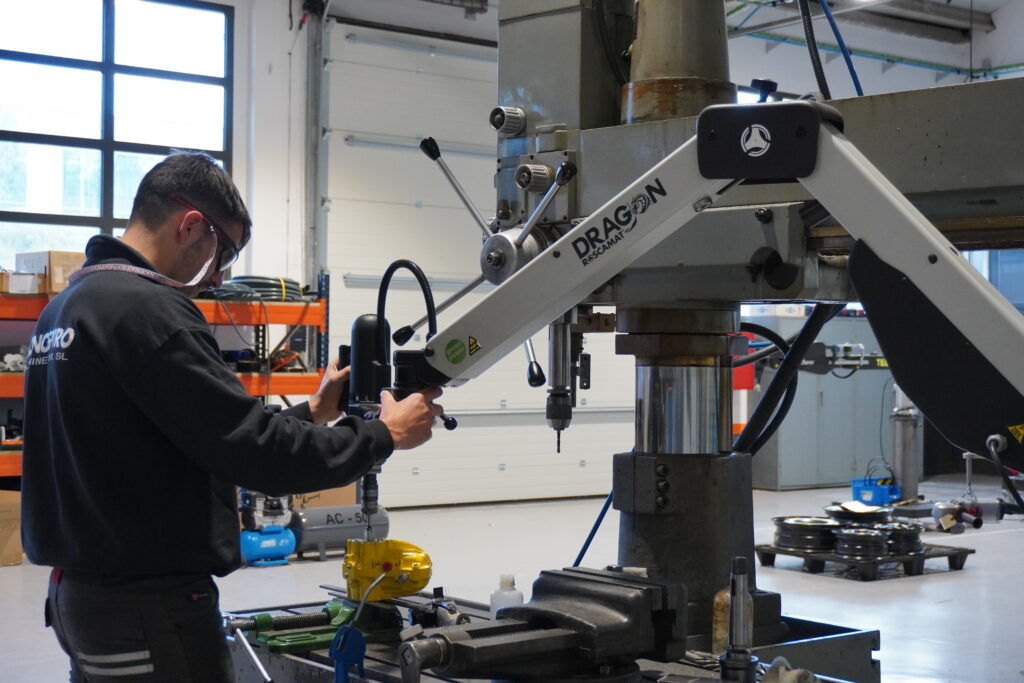
A Solution for Tapping and Machining Without Constantly Moving the Workpiece
For large, heavy or complex components, moving each workpiece to a stationary machine can generate more unproductive time than the machining operation itself. Roscamat’s approach reverses this concept: the tool moves to each working point.
This configuration allows operations to be performed at different positions on the same component and is particularly useful in machinery manufacturing, metal structures, tooling, moulds and dies, machined components and other industrial applications involving numerous holes or machining points.
The industrial articulated arm provides reach and freedom of movement while relieving the operator of the assembly’s weight. As a result, repetitive operations can be performed while maintaining a more controlled working position and reducing unnecessary handling.
Productivity Without Compromising Flexibility
In high-mix, low-volume production environments, fully automating every operation can be difficult to justify. However, maintaining entirely manual processes also introduces unproductive time, fatigue and variability.
A tapping arm occupies precisely the space between these two extremes. The operator retains control and the ability to switch quickly between workpieces or part references, while the articulated structure facilitates tool positioning.
This configuration can be particularly valuable for transferring secondary operations away from CNC machines. If an expensive machining centre remains occupied performing simple operations that could be carried out externally, moving them to a dedicated workstation makes it possible to reserve CNC capacity for higher-value processes.
Our products

ELECTRIC MACHINES
Articulated tapping arms with high frequency electric motors specifically designed for tapping with capacities from M2 up to M36 in steel.

PNEUMATIC MACHINES
Articulated tapping arms with the most durable pneumatic motors with capacities from M2 up to M24 in steel.

ACCESSORIES
Find all the accessories available for tapping, drilling, reaming and countersinking as well as to adapt the tapping arms to your work station.
Roscamat: Engineering Expertise in Industrial Tapping
Roscamat does not simply attach a support to a portable tool. Tecnospiro Machine Tool has been developing and manufacturing Roscamat articulated arms since 1987, offering electric and pneumatic solutions specifically designed for industrial environments.
The ability to select different capacities, speeds, torque levels, working reaches, heads and accessories allows each Roscamat tapping machine to be configured according to process requirements. Additional features include quick-change tap holders, safety systems and options designed for depth control and workstation adaptation.
The objective is not only to ensure that the machine can perform the operation, but also that it integrates effectively into the production workflow, helping reduce movement, auxiliary time and dependence on higher-cost machinery.
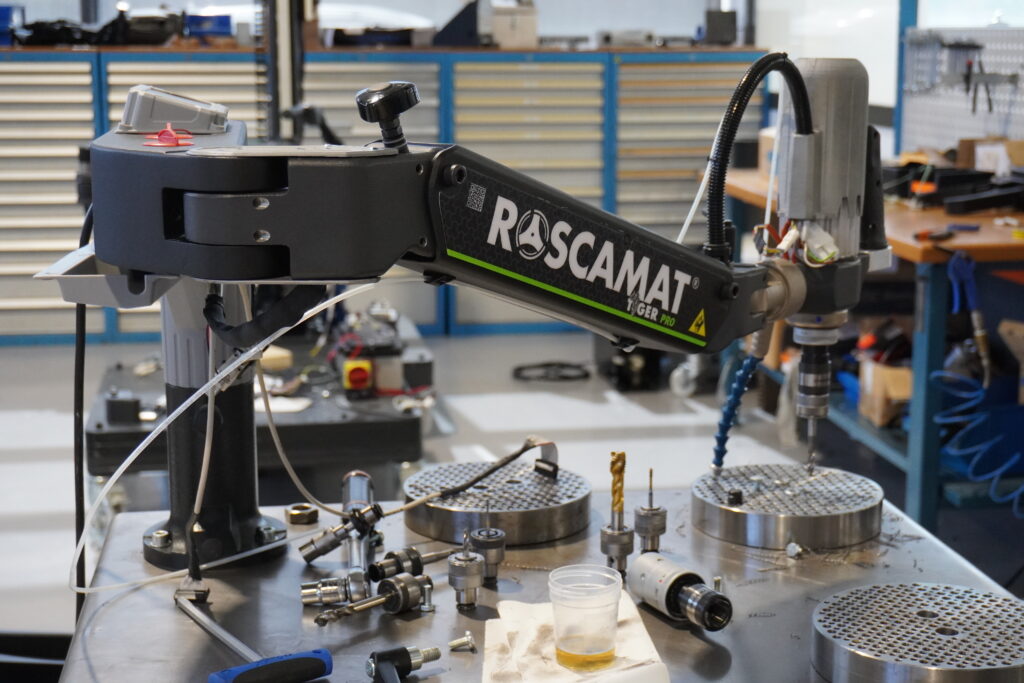
Which Tapping Machine Does Your Process Require?
There is no single optimal configuration for every application. An operation involving small components and short production runs has very different requirements from working on a large component with dozens of holes distributed across its surface.
For this reason, equipment selection should consider the material, diameters, depth, number of operations per shift, workpiece dimensions, working area and required orientation.
Tell us about the operation you need to perform. The Roscamat team can help you determine the appropriate arm, motorisation, head and accessories to make tapping and other machining operations more precise, ergonomic and productive.
Frequently Asked Questions
What Is a Drill Tapping Attachment?
In industrial applications, the term Drill Tapping Attachment may be used when searching for solutions capable of combining or facilitating tapping and drilling operations. At Roscamat, the available capabilities depend on the selected model, head and configuration, so the equipment should be specified according to the particular operation.
Can a Roscamat Arm Be Used for Drilling?
Certain Roscamat configurations allow additional operations beyond tapping, including drilling. Compatibility must be verified according to the model, tool, diameter, material and application requirements.
What Advantages Does It Offer Compared with a Manual Tool?
The articulated arm supports the assembly and facilitates positioning, improving ergonomics and control while reducing the physical effort associated with repetitive tool handling.
Can It Be Used with Large Workpieces?
Yes. One of the main advantages of the Roscamat concept is that the tool moves towards the working area, avoiding the need to repeatedly reposition heavy or bulky components in many applications.
How Do You Choose the Right Roscamat Model?
Selection mainly depends on the operation, material, diameter, required torque and speed, workpiece dimensions, working radius, orientation and production volume. Roscamat can assess these parameters to recommend the appropriate configuration.