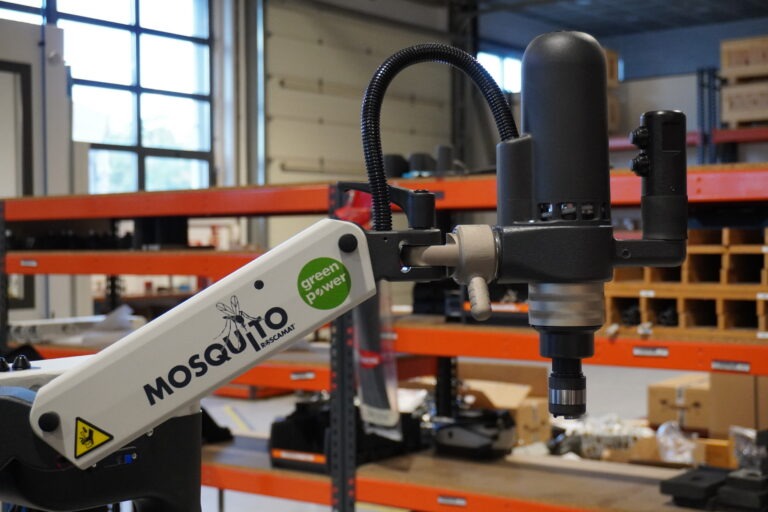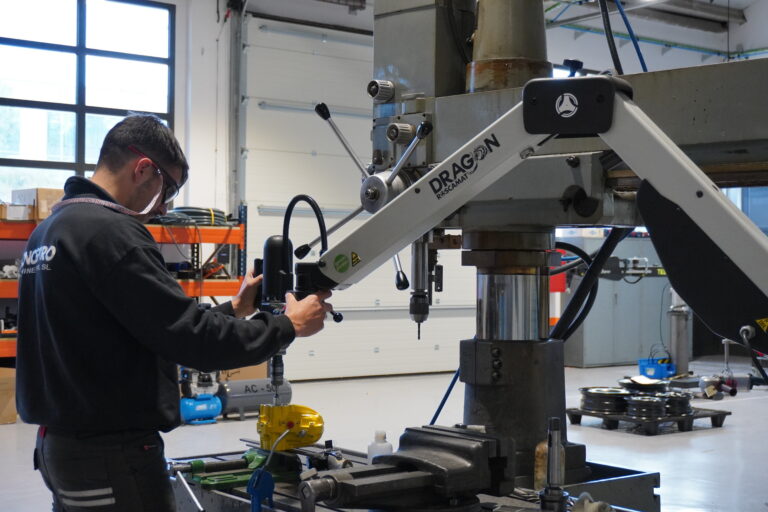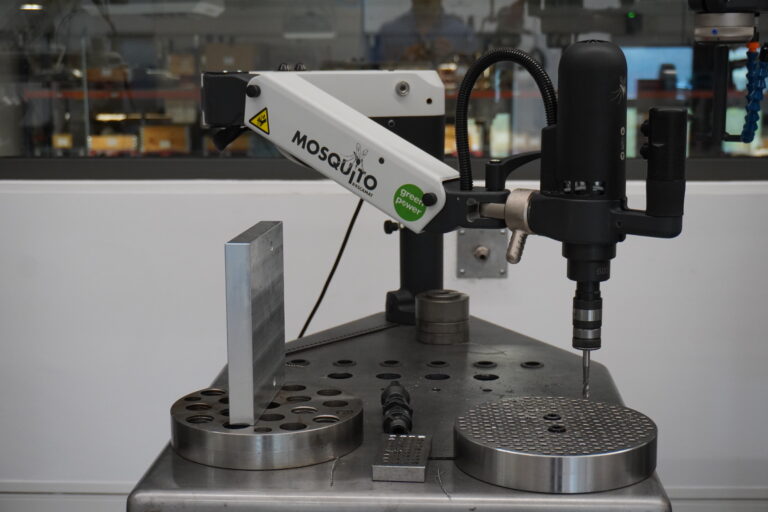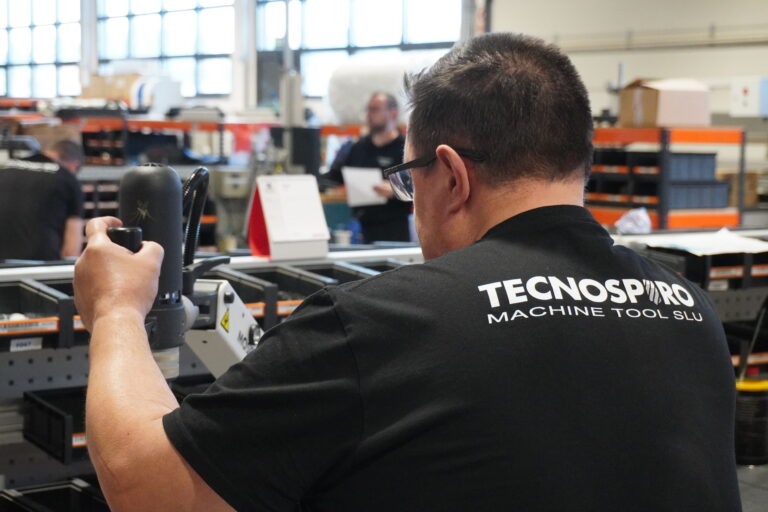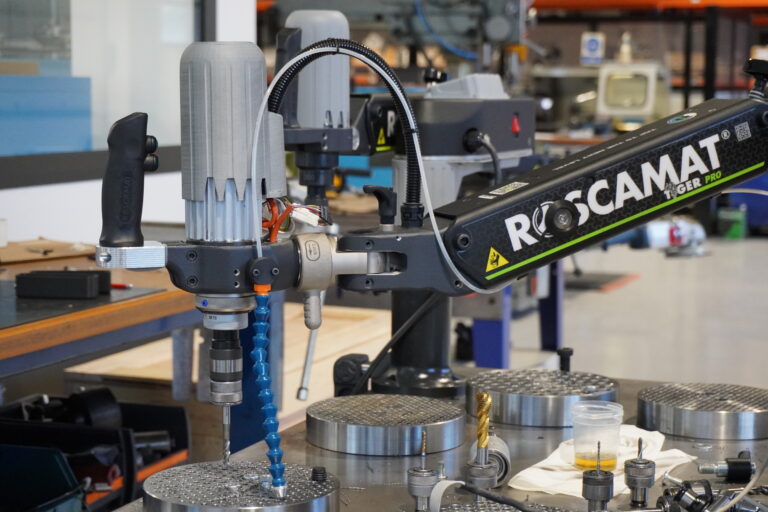
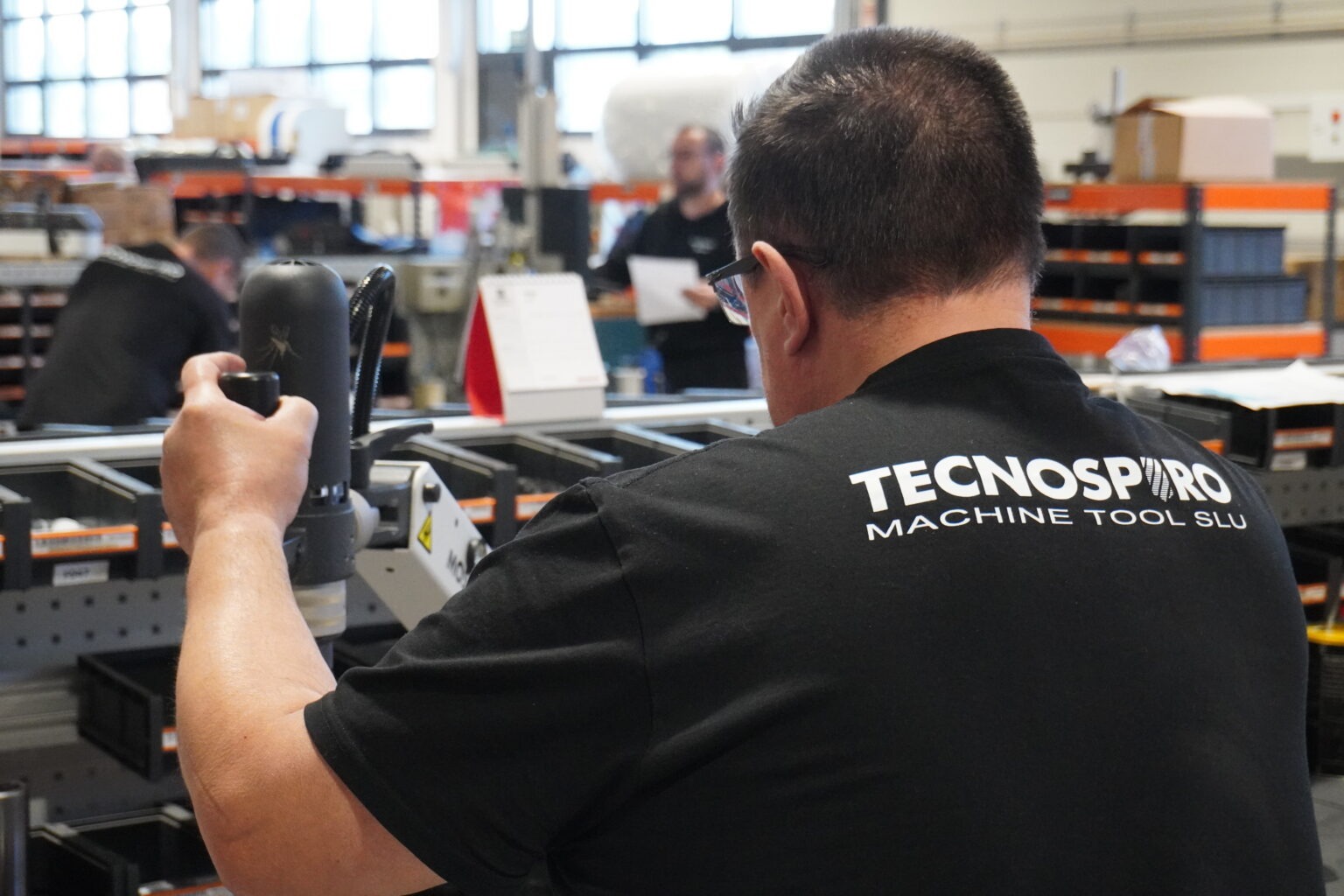
A pneumatic tapping machine can significantly reduce unproductive time in a tapping operation, but its actual performance does not depend solely on motor rpm. In high-demand environments, productivity must be assessed by considering the entire cycle: approaching the workpiece, positioning, tapping, reversing, tool changes and moving to the next hole.
For this reason, in industrial production, it is more useful to analyse completed threads per shift than the machine’s nominal speed. Combining a correctly sized articulated tapping arm, a stable compressed air supply, suitable tooling and an efficiently organised workstation can turn tapping into a highly efficient secondary machining operation.
Move Tapping Operations Away from the CNC to Recover Production Capacity
One of the first aspects to review is where tapping operations are currently performed. Keeping a CNC machining centre occupied with simple secondary operations can increase the cost per part when the same spindle could be performing higher-value machining tasks.
An independent workstation equipped with a pneumatic tapping arm allows tapping to be carried out outside the machining centre, freeing up CNC capacity. The impact should be measured across the entire production flow: if a component requires several threaded holes after primary machining, transferring this stage to a dedicated workstation can shorten lead times and prevent tapping from becoming a bottleneck.
Match Speed and Torque to Each Thread
Working faster does not necessarily mean selecting the highest possible speed. The objective is to identify the combination of rpm and torque compatible with the thread diameter, pitch, material, hole geometry and tap being used.
In the Roscamat 400, for example, the modular system features seven interchangeable modules operating between 90 and 2,100 rpm, with maximum torque values ranging from 6 to 150 Nm. This architecture allows machining tools to be configured according to each operation rather than forcing production to rely on a single compromise between speed and torque.
Reduce Tool Changeover Time
In high-mix manufacturing environments, time lost between operations can be just as significant as the actual cutting time. Quick-change tap holders allow operators to switch between thread sizes without turning every changeover into a lengthy setup process.
The advantage becomes greater when the same workstation handles different components throughout a shift: saving a few seconds repeatedly, dozens or hundreds of times, has a direct impact on the workstation’s effective production capacity.
Protect the Tap to Protect the Workpiece
Tap breakage should not be assessed solely in terms of the tool’s replacement cost. If it occurs in a component that has already undergone high-value machining, the consequences may include tool extraction, downtime, rework or even rejection of the component.
Tap holders equipped with safety clutches help limit this risk in applications such as blind holes, allowing the clutch to slip when the tap reaches the bottom. This mechanical protection contributes to process stability and helps reduce unplanned downtime.
Compressed Air Supply Also Determines Cycle Time
A pneumatic tapping machine can only deliver consistent performance if it receives the required airflow and dynamic pressure. Checking the compressor’s static pressure alone is not sufficient. An undersized hose, excessive hose length, restrictive couplings or pressure losses can cause pressure to drop precisely during the operating cycle.
Air preparation is therefore an integral part of the process. The Roscamat 400 incorporates an air preparation unit consisting of a filter, regulator and lubricator. Keeping these components correctly sized and properly maintained helps preserve the motor’s intended performance and prevents variations in the pneumatic installation from affecting cycle consistency.
Ergonomics and Working Reach: Maintaining Productivity Throughout the Shift
In repetitive operations, productivity and ergonomics are directly related. A properly balanced industrial articulated arm allows the operator to move the tapping head to each hole without continuously supporting the motor’s weight or repositioning heavy components to bring them closer to the tool.
On the Roscamat 400, the radial arm rotates through 360°, while the system maintains perpendicularity to the working area. Its working radius reaches 1,100 mm in the standard configuration and 1,220 mm in the VH version. For large components or multiple threaded holes distributed across a wide surface, this reach can eliminate auxiliary movements that add no value.
Turn Your Pneumatic Tapping Machine into a High-Productivity Workstation
Optimising tapping requires addressing the entire process. Speed and torque must match the material and thread size; compressed air must be supplied under stable conditions; tool changes must be fast; the workpiece must remain accessible; and the operator must be able to maintain production pace without unnecessary physical strain.
Roscamat has been developing articulated arms for industrial tapping since 1987 and offers pneumatic machines with capacities suited to different manufacturing requirements. If you want to reduce cycle times in your tapping operations, contact Roscamat to assess the machine configuration, working reach, speed, torque and accessories best suited to your production process.