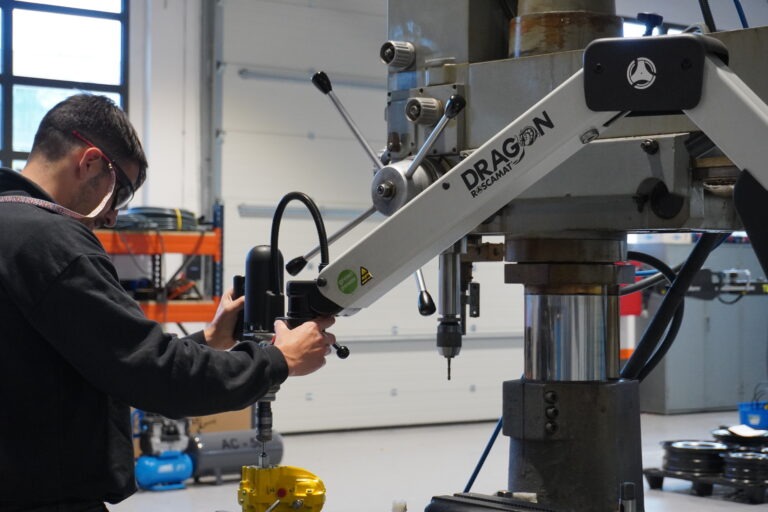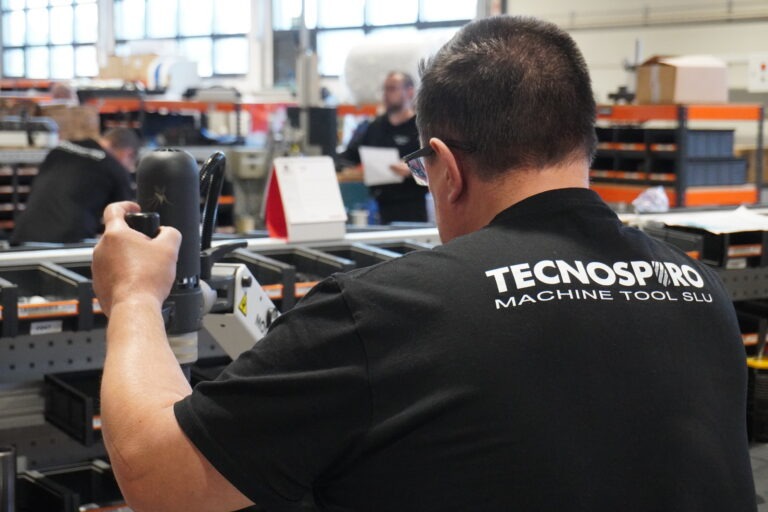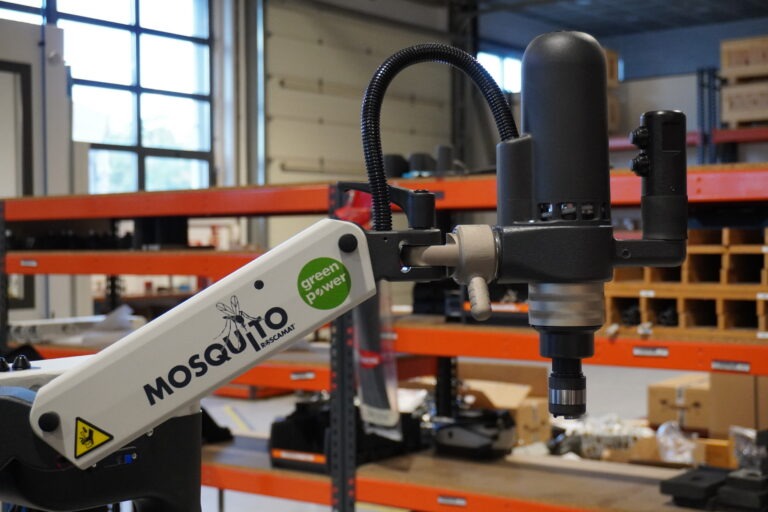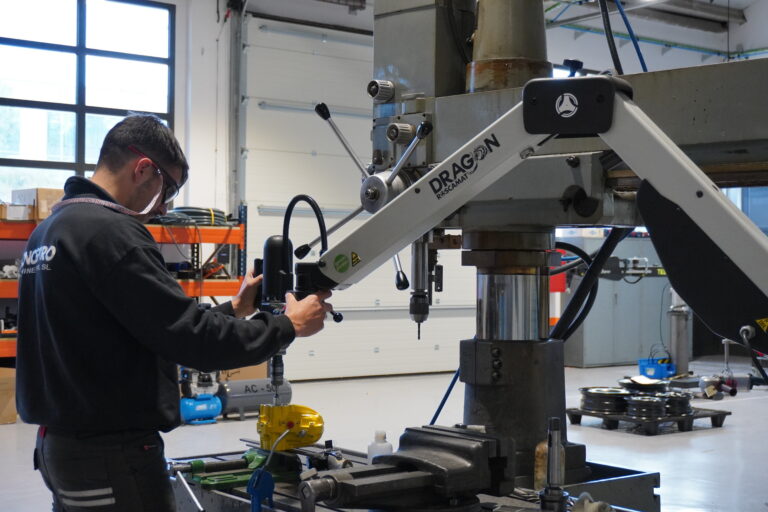
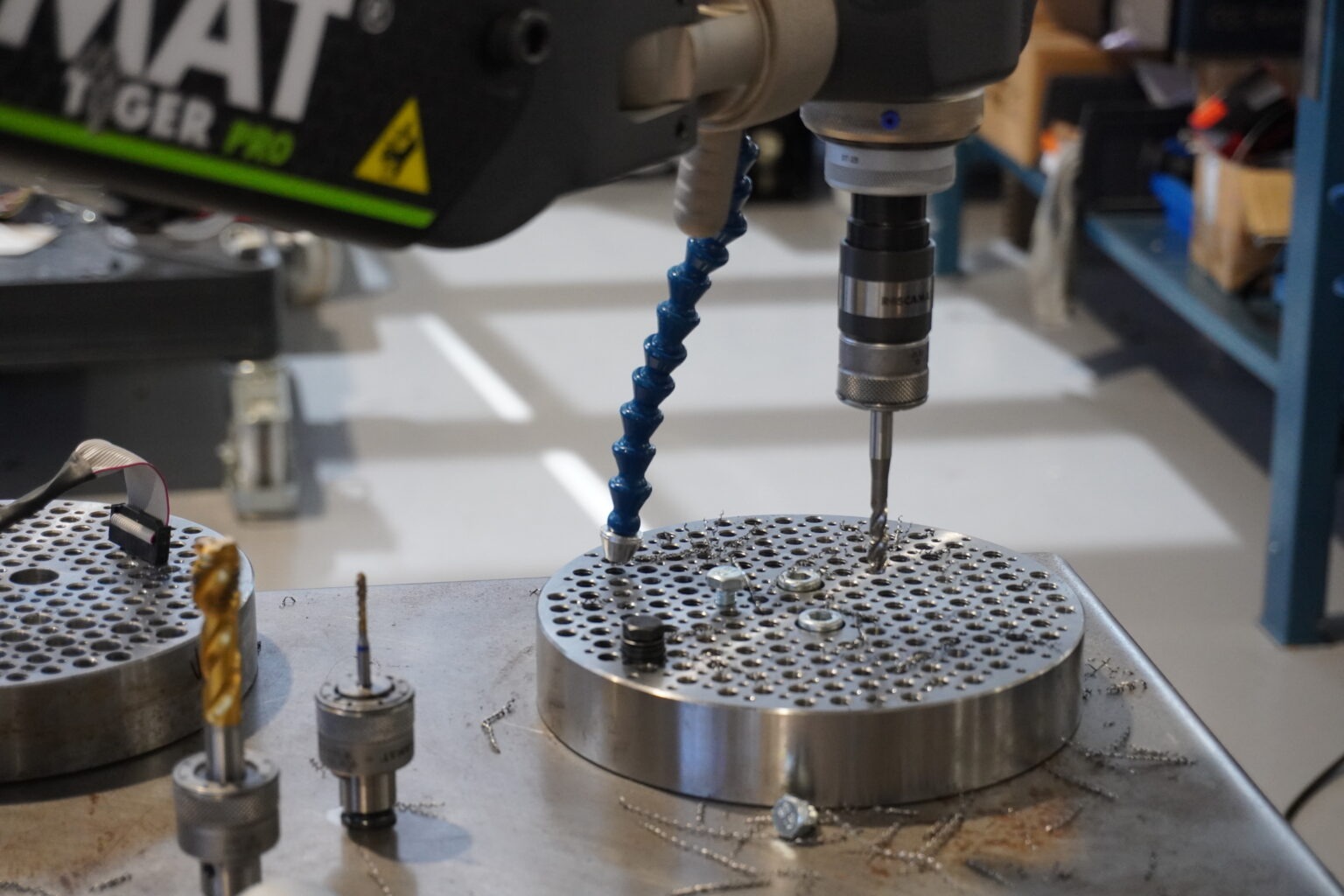
Pneumatic tapping machines provide a solution for industrial tapping operations that require flexibility, operational stability and adaptability to different workpiece geometries. Their compressed-air drive and integration into articulated arms allow threading operations to be carried out without necessarily occupying a CNC machining centre, a particularly relevant advantage in plants handling a wide variety of part references.
However, their cost-effectiveness depends not only on the industrial sector but also on production volume, thread diameters, material characteristics and tool change frequency. Industrial tapping machines meet these requirements through pneumatic solutions adaptable to different manufacturing conditions.
Automotive Industry: Component Tapping and Flexibility in Industrial Production
In the automotive industry, tapping is used in the manufacture of brackets, housings, transmission elements and components intended for mechanical assembly. Process repeatability and stability are essential to prevent defects that could compromise subsequent operations.
Pneumatic tapping machines are particularly useful in auxiliary workstations, tooling manufacture, prototyping and component production runs requiring frequent changes between part references.
The Roscamat 400 features seven interchangeable reduction modules, offering speeds from 90 to 2,100 rpm and maximum torque values of up to 150 Nm, depending on the configuration. This modularity allows tapping conditions to be adapted to the diameter, material and requirements of each operation.
Furthermore, positioning via an articulated arm facilitates access to different working points without continuously adjusting the workpiece fixture.
Aerospace Industry: Precision and Accessibility in High-Value Components
In aerospace manufacturing, tapping operations on structural components, brackets and tooling require particular attention to perpendicularity, thread integrity and process traceability.
The use of a pneumatic tapping arm may be suitable for certain auxiliary operations on workpieces with complex geometries, provided that the procedure has been validated in accordance with manufacturing specifications.
The articulated system facilitates tool positioning and reduces the need to handle large components. Nevertheless, final accuracy also depends on hole preparation, tap geometry, lubrication and control of cutting parameters.
In critical applications, equipment selection must consider the inspection and validation requirements established by the component manufacturer, as pneumatic operation alone does not guarantee compliance with aerospace tolerances.
Metalworking Industry: Productivity and Efficient Use of CNC Machining Capacity
In machining workshops, tool and die shops, and machinery manufacturing facilities, tapping operations can account for a significant proportion of the time devoted to finishing processes.
Moving certain operations to an independent workstation allows CNC machining centres to be reserved for milling, turning and other more complex processes. This strategy is particularly useful when workpieces require multiple threads or when changes between part references reduce machine availability.
The Roscamat 200, with a tapping capacity from M2 to M14, extendable to M16 depending on the material, is designed for smaller-diameter tapping applications. Its pneumatic configurations offer speeds of 350 or 750 rpm and maximum torque values of 30 or 17 Nm, respectively.
For larger components, the Roscamat 500 extends the working area through longer arms, facilitating access to distant working points without continuously repositioning the workpiece.
Technical Criteria for Selecting a Pneumatic Tapping Machine
Selection should begin with the maximum thread diameter, material strength and required torque. Arm reach, head orientation and compressed-air supply conditions must also be evaluated.
For deep threads or blind holes, tap holders with safety clutches can limit certain overloads, while suitable lubrication systems help reduce friction and tool wear.
Actual productivity will depend on the combination of tapping time, preparation, positioning and workpiece handling, rather than exclusively on the motor’s nominal speed.
Roscamat: Pneumatic Solutions for Different Industrial Sectors
With a history dating back to 1987, Roscamat develops and manufactures industrial tapping arms for machining workshops, component manufacturers, mould makers and tool and die manufacturers.
Contact the Roscamat team to assess your process requirements and select a pneumatic tapping machine suited to the material, thread diameter and production demands.